
The USA at 250
A Brief Reflection on Repair


We Are a Divided People
The fact that our country is challenged by partisanship and division is one of the few topics upon which Americans across the political spectrum can agree. The division is so extreme that people are hyper-focused on “winning” highly polarized political contests and debates, even if doing so deepens the fissures in our common life. There is little focus on restoring our civic virtue and reclaiming our ability to debate and disagree without hatred and rancor. The notion that we can work together and compromise for the common good does not seem to exist.
We Must Repair Our Divisions First
I believe that repairing our civic capabilities is the most important task we face today. We live in a world beset by crises that mutually interact and exacerbate each other, creating what French complexity theorist Edgar Morin called a polycrisis. Because of the urgency of many of these crises, it is tempting to bypass civic repair and to continue to engage in divisive fighting to win enough power to do something about a different crisis of concern. But as the USA’s “we’re in, we’re out, we’re back in, nope — we’re out again” approach to the Paris Climate Accord shows, without a unified sense of purpose we are impotent to address the urgent challenges we face.
Repairing our divisions is really hard work, because our deep suspicion—even hatred—of those with whom we disagree means that we would prefer not to engage with them. The very nature of our problem makes taking the necessary steps to solve the problem difficult.
Repair Starts with Stabilizing Our Minds
The answer to this difficulty is for citizens committed to repairing our civic breach to begin to work with our own minds in order to build the stability and tolerance needed to engage those who hold views we find problematic or offensive. With this stability, we can then adopt other practices that allow us to engage in constructive speaking and deep listening, which can foster true communication and catalyze the transformation of our shared situation.
Tibetan Abbot: Can we cover the earth in leather so it is soft wherever we go?Student: No.
Abbot: So what can we do?
Student: Cover our feet in leather?
Abbot: Yes, covering our feet in leather is equal to covering the earth with leather.
Likewise, enemies are as limitless as space. All enemies cannot possibly be overcome. Yet if one can just overcome hatred, this will be equal to overcoming all enemies.All that is unsatisfactory in this world, all the fear and suffering that exists—clinging to the “I” has created it. What am I to do with this great demon?
To release myself from harm and to free all others from their suffering, let me give myself away and love others as I love myself.
— From the movie The Cup, directed by Khyentse Norbu.
In 1966 during the darkest days of the Vietnam war, Zen Buddhist monk Thich Nhat Hanh (Thay) looked deeply into the conflict and formulated the Fourteen Mindfulness Trainings as medicine to help address the war raging in his country. While all of the trainings apply to our situation, trainings 1-6, 8, and 9 are particularly important. They can serve as the basis for how we gain the stability and skills necessary to engage in true dialog.
Martin Luther King, Jr. met Thich Nhat Hanh twice, once in 1966 (the year Thay wrote the Fourteen Mindfulness Trainings) and again in 1967. Thay’s ideas about peace made a significant impression on Dr. King, and in January of 1967, King publicly1 nominated Thich Nhat Hanh for the Nobel Peace Prize.
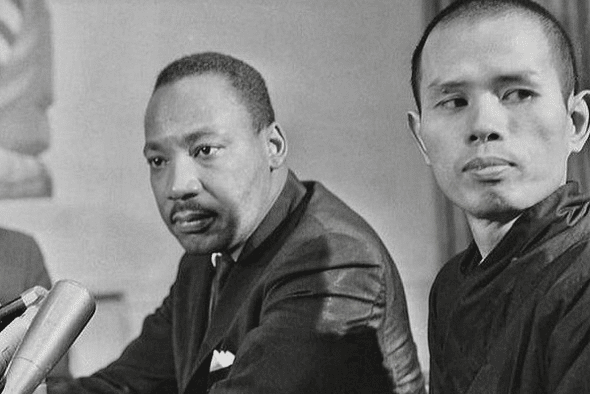
“his ideas for peace, if applied, would build a monument to ecumenism, to world brotherhood, to humanity.”
— Martin Luther King, Jr in his letter nominating Thich Nhat Hanh for the Nobel Peace Prize
Join the Journey
At St. Bartholomew’s Episcopal Church in NYC, we are celebrating the country’s 250th anniversary by studying Jeremy David Engels’ book On Mindful Democracy during the month of July. Our aim is to mend our fractured nation, which is what the book’s subtitle offers as its promise. We meet on Zoom on Wednesday nights from 7:00-8:00 PM EDT. If you want to join but cannot make all of the meetings, the sessions will be recorded and shared with you. You can learn more about the group and sign up to receive the Zoom link here. Please join us and become part of the essential movement to heal our shared civic life.
King made the nomination public, which was a breach of the Nobel committee's norms — nominations are supposed to remain confidential — and some have speculated this contributed to the committee's decision not to award any Peace Prize in 1967.